
August 10, 2026 – by Santina Russo
In electronics and materials sciences, a lot depends on the band gap. A band gap is the energy difference between different electronic states in a material. It controls many electronic processes and determines whether a material behaves as a metal, a semiconductor, or an insulator. It also shapes important functional properties.
A relevant practical example are solar cells. In a solar cell, the energy of incoming photons excites electrons from the valence band to the conduction band. When the various factors that influence how efficiently photons are absorbed are taken into account, it turns out that a solar cell needs a band gap of slightly more than one electronvolt to achieve maximum efficiency. For other electronic applications, different gaps are optimal. “Take gallium nitride, for example: its band gap of 3.5 electronvolts makes it a perfect material for blue LED lasers,” says Stefan Riemelmoser, senior scientist at the Chair of Atomic-Scale Simulation at EPFL.
It is therefore important, that simulations determine a material’s band gap accurately. But that’s not easy. One of the most widely used mathematical frameworks for material simulations, density functional theory (DFT), is notoriously underestimating band gaps. Sometimes this even leads to results that wrongly predict a semiconductor to have metallic properties.
Now, Stefan Riemelmoser, Xun Xu, and Alfredo Pasquarello at EPFL have developed an improved quantum-physics component for these simulations. Using it, they achieved the gold standard accuracy for band-gap results set by many-body methods—another widely used, but much more computationally expensive approach.
Building on decades of progress
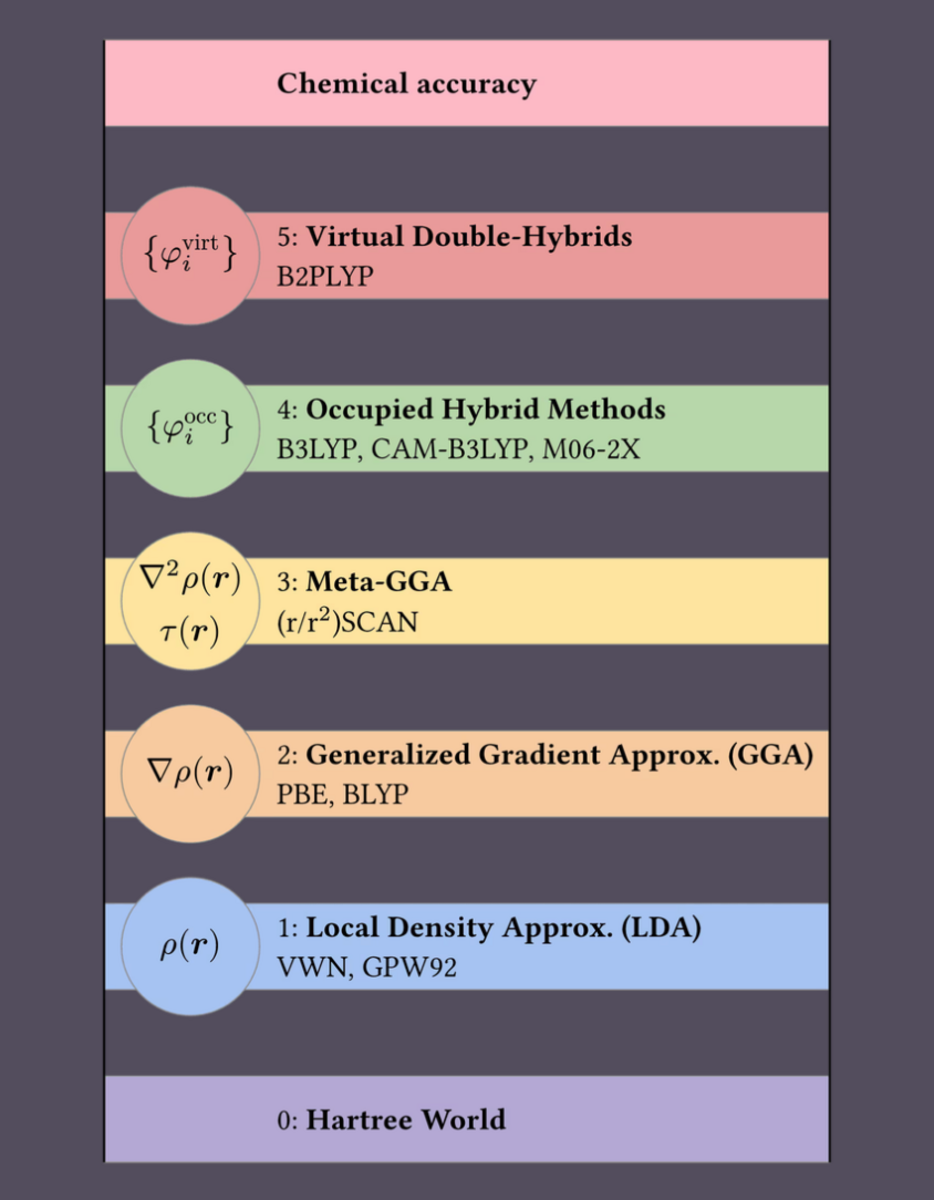
A key component of DFT is the density functional. It describes quantum effects arising from interactions between electrons, known collectively as the exchange-correlation energy. For systems containing more than one electron, these effects cannot be calculated exactly, so physicists rely on approximations. Over the past decades, these approximations have gradually been refined and become more sophisticated. The first was the local density approximation (LDA), introduced in the 1960s. It assumes that the system depends only on the local electron density. “This is the simplest and usually the cheapest approximation in terms of computational cost,” Riemelmoser explains.
In the 1990s, the generalized gradient approximation (GGA) emerged, followed in the 2010s by the meta-generalized gradient approximation (meta-GGA). GGA adds information about how rapidly the electron density changes in space. Meta-GGA includes further information, such as the kinetic-energy density of the electrons.
In parallel, researchers develop another class of approximations: hybrid functionals, which Riemelmoser has now used as basis for his new approach. These functionals combined GGA, and later meta-GGA, with a fixed proportion of what is known as Fock exchange. The Fock exchange is important because it accounts for the quantum-mechanical tendency of electrons with the same spin to avoid one another. Such hybrid functionals can correct the band gap error of DFT, because mixing in Fock exchange generally increases the band gap.
Each new generation of these approximations added further physical ingredients, making the calculations more accurate—but also more computationally demanding.
Adding a material-dependent ingredient
Using the computing power of CSCS’s Alps supercomputer, the team has now taken these decades of developments one step further. For the first time, they combined an advanced meta-GGA representation with a more sophisticated mixture of Fock exchange that depends on the material being studied.
The new functional is called DD-r2SCANH. Its name reflects its two main components: r2SCAN refers to the advanced meta-GGA, while DD stands for dielectric-dependent, because the functional adapts to the dielectric constant of each material.
Result: much greater accuracy
Using the VASP package for quantum-mechanical materials simulations, Riemelmoser and his colleagues extensively validated this new functional. Taking advantage of the GPU acceleration available on Alps, they benchmarked it on almost 40 different materials, carrying out hundreds of highly accurate ab-initio calculations and comparing its performance with that of existing functionals.
The results are excellent: DD-r2SCANH achieved an average error of just +/- 7 percent—lower than for any previous hybrid functional of this type. For comparison, an existing functional that combines the state-of-the-art GGA component PBE with a dielectric-dependent Fock exchange has an average error of 27 percent. And an r²SCAN-based hybrid functional with fixed mixing fraction performs even worse with an average error of 64 percent. “This shows the importance of a material-dependent Fock exchange,” says Riemelmoser.
The improvements are particularly striking for so-called narrow-gap semiconductors, such as germanium and indium arsenide, whose band gaps are below one electronvolt. Previous functionals consistently underestimated these band gaps, and some even wrongly predicted the materials to have metallic properties. In contrast, DD-r2SCANH reproduces their experimentally determined band gaps correctly.
Accuracy comparable to powerful many-body methods
“The new functional, DD-r2SCANH, now yields results comparable to those of state-or-the-art many body-methods,” says Riemelmoser. Alongside DFT, many-body methods are another widely used approach in materials simulations. They have generally produced significantly more accurate results than DFT, but at far greater computational cost. Hybrid functionals are typically 100 to 1000 times faster. With the newly developed DD-r2SCANH functional, DFT retains its advantage in speed while achieving an accuracy comparable to that of many-body methods.
“Many-body methods are also cumbersome to apply in practice, which limits their widespread use,” says Riemeloser. According to him, the same can be said for other versions of accurate materials-dependent hybrid functionals. “Our philosophy was to create a minimalist hybrid functional that can get the fundamental physics right.”
The team’s new functional thus brings together three advantages: computational requirements that are feasible to investigate a variety of materials, a high accuracy of the simulations, and a streamlined functional form that new users can easily pick up.
Cover image: polycrystalline silicon solar cells (Adobe stock)
Reference:
S. Riemelmoser, X. Xu and A. Pasquarello: Dielectric-dependent hybrid functional based on meta-GGA. Nat Commun (2026). DOI: https://doi.org/10.1038/s41467-026-75146-x