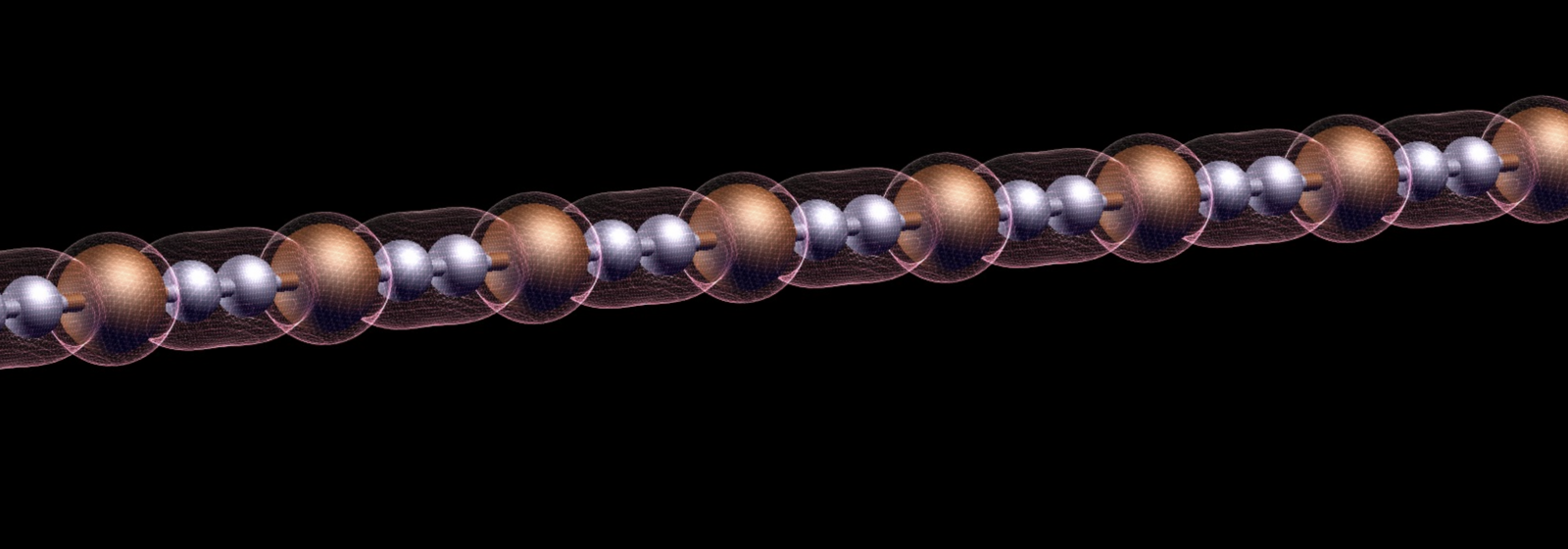
October 12, 2026 – by Santina Russo
Recent years have seen the emergence of 1D materials as a promising new resource for next-generation applications in nanoelectronics, sensing, and quantum electronics. These materials consist of strings only one or a few atoms thick. In such ultrathin structures, quantum and surface effects become particularly important, creating electronic, optical, and mechanical properties that can be very different from those of the same material in bulk form. Recently, using CSCS supercomputing resources, scientists at EPFL and Harvard University identified and characterised a number of novel 1D materials. Among other things, they found what could be the thinnest possible metallic wire that can be produced by exfoliation.
Exfoliation—a practical synthesis method
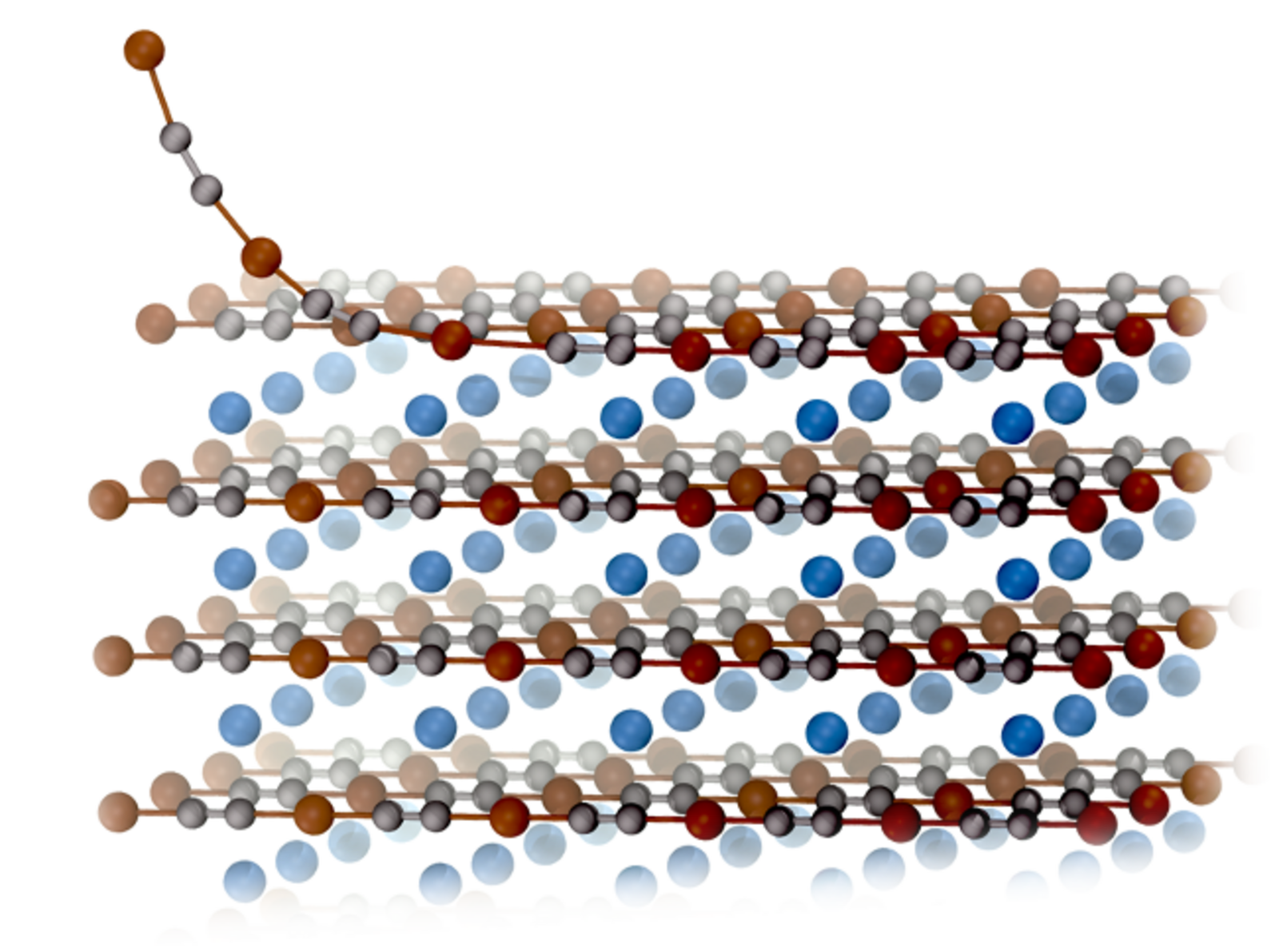
Exfoliation can be thought of as a rather natural way of extracting 1D or 2D materials from their 3D bulk counterparts, without having to synthesise them from scratch. A well-studied example is graphene, which can be obtained from graphite. Graphite is composed of graphene layers stacked on top of each other. While the atoms in each layer are held together by strong chemical bonds, only weak van der Waals forces act between the layers. This is why individual sheets can be peeled off from the bulk material.
In a similar way, certain 1D materials can be exfoliated from their 3D counterparts. “Here, the 3D structure is composed of adjacent strands that are only weakly bonded to each other, while the strands themselves are held together by strong chemical bonds—and can therefore be separated from the 3D structure,” explains Chiara Cignarella. Formerly at EPFL in the group of Nicola Marzari and now a postdoc at Harvard University, she is the first author of several papers that identified and analysed exfoliable 1D materials and revealed some of their particularly interesting properties.
From theory to practically useful properties
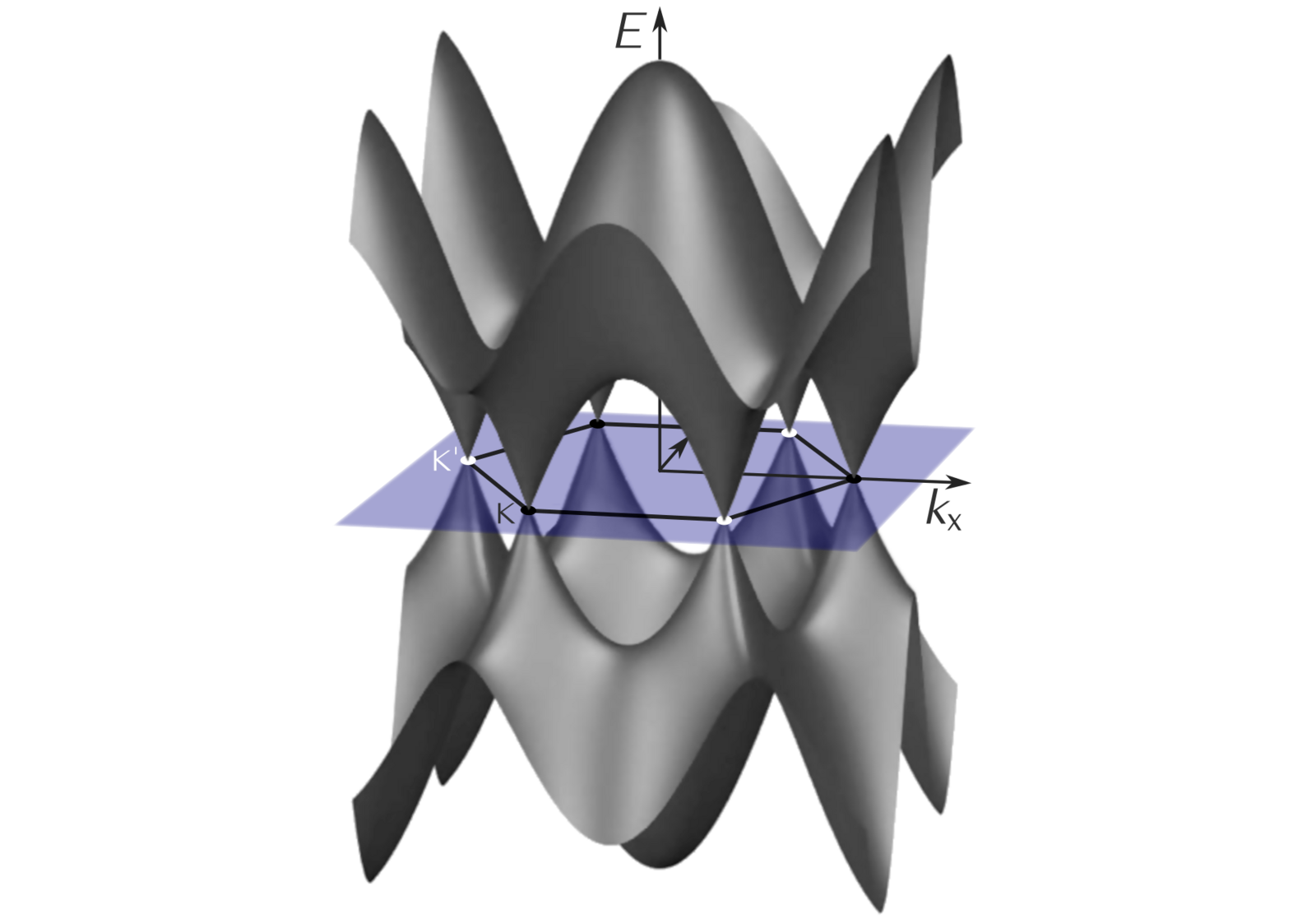
“The fact that 1D wires possess exotic properties is not surprising,” says Cignarella. “When you reduce the dimensionality of materials, the resulting properties are always extreme.” This has to do with the materials’ electronic structure: in 1D materials, electrons can move freely in only one direction. “Mathematically, this means that you get an increase in the number of electrons that localize near the Fermi energy,” Cignarella explains. These electrons are the first to respond to energy entering the system, for example in the form of light or heat, which makes them crucial for properties scientists and engineers look for in new materials, such as high heat capacity or electrical conductivity.
In their project, Cignarella and her co-workers Davide Campi and Nicola Marzari started with a database containing many thousands of 3D materials and screened them for their potential to yield 1D counterparts through exfoliation. By analysing the distances between atoms, they could distinguish strong from weak bonds. “In our case, we looked for materials that are weakly bonded in two directions and therefore likely to yield 1D wires through exfoliation,” Cignarella says. This initial screening produced roughly 800 exfoliable 1D materials.
How to simulate 1D wires
In a second step, the researchers used CSCS supercomputing resources and density functional theory (DFT) to determine the structure of these 800 materials and to investigate their electronic and mechanical properties for potential applications in nanotechnology. In a third step, they computed the properties of the 14 most promising materials for metallic applications with higher accuracy.
These calculations were an elaborate undertaking, and not just because of the large number of structures simulated. “For 1D wires, DFT calculations are more computationally demanding than for 3D materials,” says Cignarella. To simulate 1D chains correctly, the scientists needed to surround them with a vacuum buffer zone, which increased computational cost. “Without a supercomputer, these calculations would not have been possible,” the physicist says.
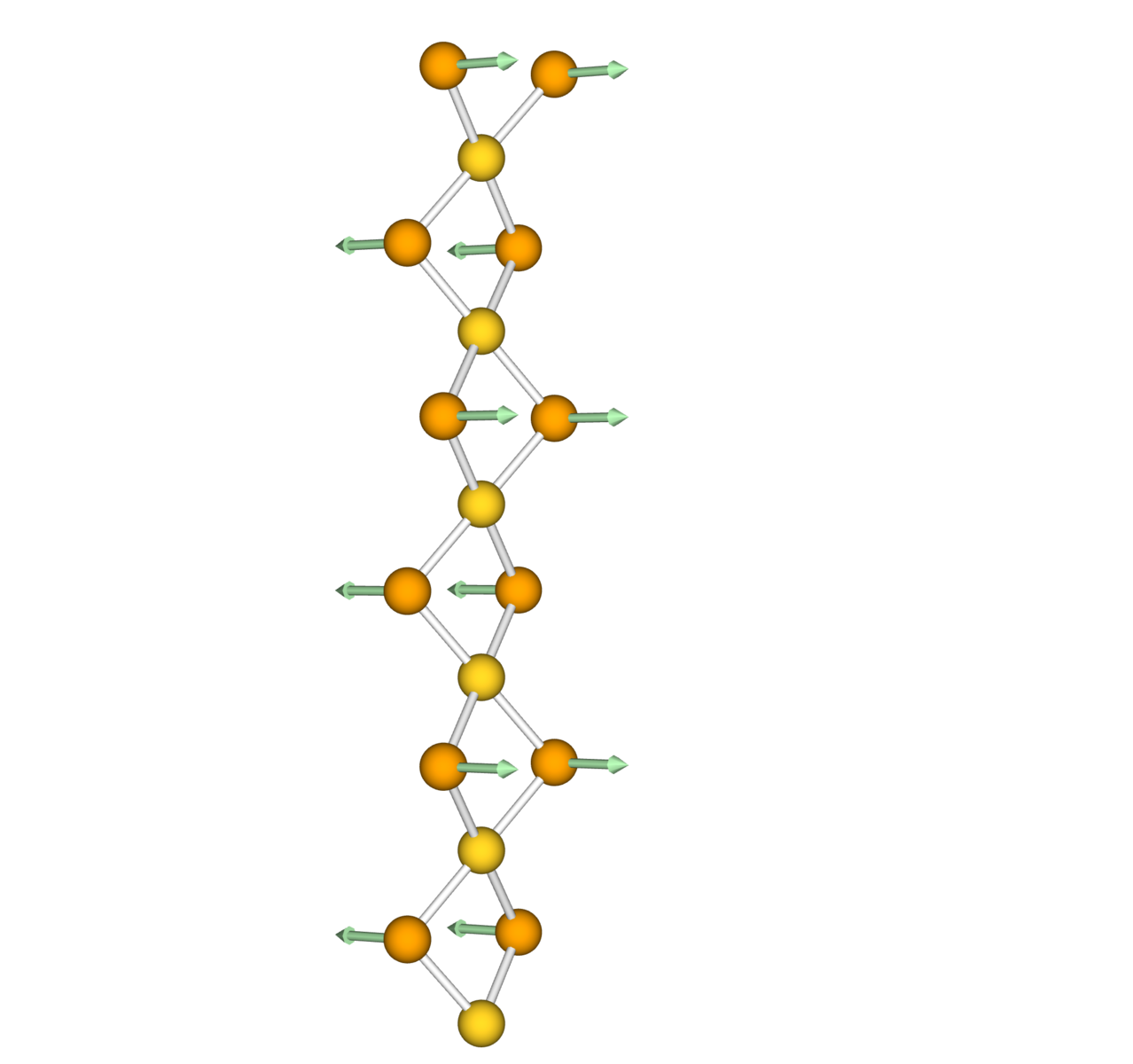
In addition, she and her colleagues analysed the materials’ so-called phonon dispersion. Simply put, this quantity describes vibrations in a material and how they propagate from one atom to the next. This is important because it helps determine a material’s stability—and because 1D wires are particularly tricky when it comes to stability, especially in their metallic state. “The overwhelming majority of 1D materials are unstable in their metallic state, except at very low temperatures,” confirms Cignarella.
Rare finds: stable 1D metals
Notably, her DFT calculations and the analysis of the resulting structures revealed several stable 1D metal wires. One of them is copper carbide (CuC2), which, according to the results, constitutes the thinnest metallic wire known to date—and therefore offers the most potential for minimization. Another analysed material is tantalum triselenide (TaSe3), which interestingly had already been exfoliated and studied decades earlier and shown to possess remarkable electronic properties. For example, it can sustain very high current densities, making it a promising candidate for future interconnects between transistors in electronic chips.
There is need for such an alternative: today’s interconnects are made of copper, but constructed at the nanoscale its performance tends to deteriorate. “We therefore need metallic materials that have small dimensions naturally, through their basic structure, such as 1D wires,” says Cignarella.
The basis for future technologies
The team also identified several novel 1D semiconductors, such as AuSe2, As2S3 and Bi2Te3, and found that they also possess unusual electronic and thermal properties. For instance, such 1D wires generally show negative thermal expansion—an unusual behaviour in which a material contracts when heated instead of expanding. “Such exotic properties can be very useful in combination with more conventional materials, for instance for precision instruments in optics and electronics,” says Cignarella.
She is now working to make all the data on the investigated 1D systems available on an open-source web platform. “Today, we have very powerful computers and other electronic devices, but they are not based on the most advanced materials investigated in research,” says the physicist. The search for new 1D materials therefore holds considerable potential for the next generation of transistors—ultimately the fundamental building blocks of our technologies.
Cover image: Copper carbide (CuC2) is one of the 1D materials identified in this work and the thinnest metallic wire known to date. (Image: C. Cignarella)
References:
S. Grillo, Ch. Cignarella, F. Bechstedt, P. Gori, M. Palummo, D. Campi, N. Marzari, and O. Pulci: Quasiparticle Effects and Strong Excitonic Features in Exfoliable 1D Semiconducting Materials. ACS Nano (2026) 20 (3): 2664–2677. DOI: https://doi.org/10.1021/acsnano.5c14061
Ch. Cignarella, L. Bastonero, L. Monacelli, and N. Marzari: Extreme Anharmonicity and Thermal Contraction of One-Dimensional Wires. Nano Lett. (2025) 25 (44): 15919–15926. DOI: https://doi.org/10.1021/acs.nanolett.5c04282
Ch. Cignarella, D. Campi, and N. Marzari: Searching for the Thinnest Metallic Wire. ACS Nano (2024) 18 (25): 16101–16112. DOI: https://doi.org/10.1021/acsnano.3c12802