March 30, 2026 – by Santina Russo
It’s hard to even imagine them: supermassive black holes. With masses ranging from at least one hundred thousand to many billions of times that of our Sun, they are the largest type of black hole known. They are found at the centres of most, and probably all, large galaxies, including our Milky Way. At its centre sits Sagittarius A*, a black hole with a mass of about four million Suns.
But even these giants cannot be seen directly. Astrophysicists infer their presence by tracking the rapid orbits of nearby stars and gas, and by measuring the radiation emitted by matter falling in. Now, Lucio Mayer’s team at the University of Zurich, together with colleagues in Italy, the UK and the US, has used simulations to analyse what happens during a specific type of disruption event, in which a star is destroyed under the influence of a supermassive black hole. In the process, the researchers uncovered a previous misconception and moved closer to their goal of discovering far more black holes in the future.
When stars are torn apart
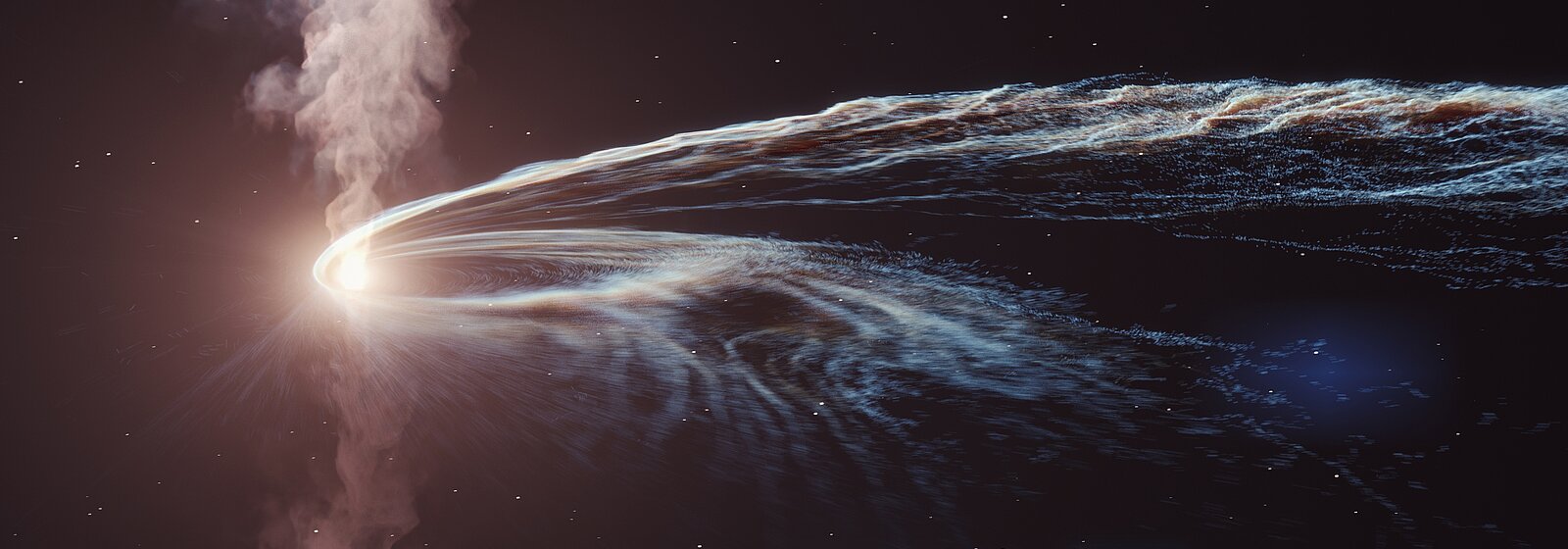
In these tidal disruption events, as astrophysicists call them, a star is captured by the black hole’s gravitational field. Because this gravitational force affects the star more strongly at certain positions, the star is basically torn apart. It is stretched into a long, thin stream of debris that revolves around the black hole. “This phenomenon gives rise to bright luminosity that can be observed with telescopes and used to locate supermassive black holes,” says Lucio Mayer, professor at the Department of Astrophysics at the University of Zurich and principal investigator of the project. However, scientists still do not know exactly how this luminosity is produced.

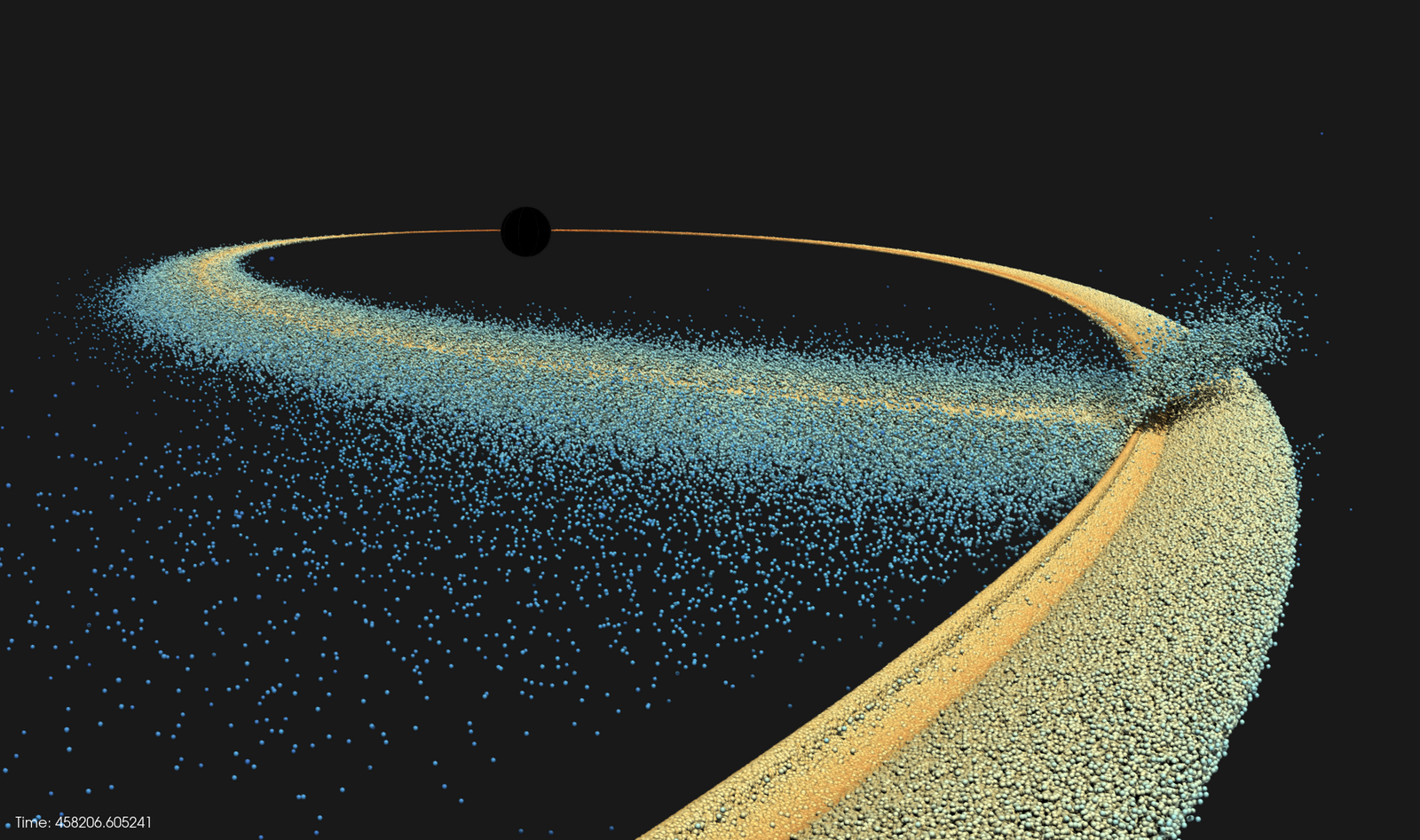
Now Mayer and his team’s simulations have shown the luminous debris stream of a dying star with a level of precision never seen before. This was possible because their high-resolution simulations, run on CSCS’s powerful Alps supercomputer, included far more gas particles than earlier ones. As a result, the team was able, for the first time, to observe the exact pattern of the debris stream around the black hole in a simulation.
“This was crucial because the stream wraps around the black hole in a complex way, even intersecting itself,” Mayer explained. “Any small error in capturing the trajectory can result in a completely different evolution of the stream—and lead to wrong conclusions about how the observed luminosity is produced.”
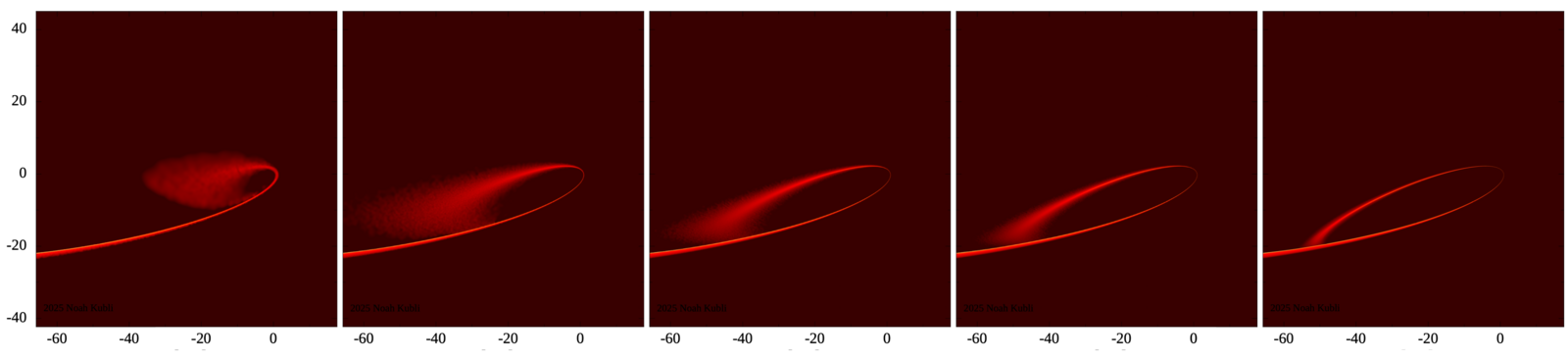
In fact, the correct trajectory had been missed in earlier simulations with fewer particles, because the stream was not resolved well enough. In particular, previous simulations were not able to handle the extreme conditions and the shocks developing in the flow close to the black hole. Instead, they produced heat dissipation that caused the stream to expand into a spray, which would appear as a bright flare. This led to the hypothesis that this process was a significant source of the observed luminosity.
Higher-performing GPU-based code
The new simulations, however, have painted a very different picture. “We have now shown that, in reality, there is no spray, but that it instead arises from a numerical effect caused by the low resolution of previous simulations,” says Mayer. At the same time, the team can now follow the correct and detailed evolution of the stream and investigate the newly apparent self-intersection. Indeed, this phenomenon could well be a major source of the observed luminosity.
The reason Mayer’s team was able to compute simulations at a much higher resolution than before is a newly developed code called SPH-EXA. It combines smoothed-particle hydrodynamics—a method that solves the equations of fluid dynamics using moving particles, each carrying mass, velocity, energy, and other properties—with an accurate gravity solver. And: SPH-EXA is the first smoothed-particle hydrodynamics and gravity code that runs entirely on GPUs and is therefore optimized for the Alps supercomputer’s powerful hardware. “This provides a major speed advantage,” says Noah Kubli, a PhD student in Mayer’s group and first author of the paper describing the project. “It means that we can simulate systems at much higher resolutions and over longer timescales.”
According to the team’s results, performance increased by two orders of magnitude. In their simulations, the researchers were even able to follow up to two trillion (10¹²) particles over a short period, whereas previous simulations were limited to a little over 120 million particles.
Sleeping black holes
Through their analyses of tidal disruption events, the researchers hope to infer properties of the black holes like their mass and spin. “This would allow us to obtain information about dormant supermassive black holes—those sitting inactive at the centres of galaxies, not accreting stellar material,” says Kubli. The team is also working to model not only supermassive black holes, but intermediate-mass ones as well. Theoretical models predict that many such intermediate-mass black holes should exist. But so far, apart from a few tentative observations, there is no proof that they do. “Intermediate-mass black holes are important for understanding how black holes formed in the first place, from the early Universe until now,” Kubli explains.
While active supermassive black holes can be detected through the light emitted by hot interstellar gas accreting in a disk and falling inward, there is still no method to detect dormant ones, or the many black holes of intermediate mass. This could be possible, however, by observing tidal disruption events, as they can be detected even if a black hole is not actively interacting with interstellar gas.
Searching for far more black holes
That is why Mayer and his team have high hopes for the Rubin Observatory in Chile, which started operations in summer 2025. Among other phenomena, the telescope is expected to identify tens of thousands of tidal disruption events. For comparison, until now only a little over a hundred of these events had ever been recorded. “With the Rubin telescope, we will obtain much more data on tidal disruption events, and therefore on dormant and intermediate-mass black holes,” says Lucio Mayer. “It’s as we are in a dark room that the tidal disruption events will hopefully light up—and show us much more of the entire black hole population.”
Cover Image: An illustration of a tidal disruption event. The debris stream comes from a star destroyed in the black hole’s gravitational field, and the arising illumination can be captured by telescopes.
(Image Credit: Science Communication Lab, DESY)
SPH-EXA: a PASC achievement
Since its launch in 2013, the Platform for Advanced Scientific Computing (PASC) has supported the development of computer applications for future exascale-class systems. The new code used by Lucio Mayer and his co-workers, SPH-EXA, was developed within this platform through an interdisciplinary collaboration between scientists and computer engineers. It is the first code to combine smoothed-particle hydrodynamics (SPH) with a gravity solver, while having every part of the code optimized to run on GPUs.
As Lucio Mayer explains, one advantage of using SPH to simulate the gas flow around a black hole is that the velocities and densities of the particles can be tracked as they evolve over time. Compared with the other main method used in the field—a mesh-based finite-volume approach, which works well for discontinuities in the flow such as shocks—SPH allows for a better representation, especially at the very high velocities of stars and ultra-hot gas particles around black holes.
The development of SPH-EXA was led by the groups of Florina Ciorba at the University of Basel and Lucio Mayer at the University of Zurich, in collaboration with Sebastian Keller, a senior software engineer at CSCS who has contributed key components of the code such as the state-of-the-art gravity solver and its unique scalability on GPU architectures.
Reference:
N. Kubli, A. Franchini, E.R. Coughlin, C.J. Nixon, S. Keller, P.R. Capelo, and L. Mayer: Tidal Disruption Events with SPH-EXA: Resolving the Return of the Stream. (2026) ApJL999 L40. DOI: doi.org/10.3847/2041-8213/ae4748