August 3, 2026 – by Santina Russo
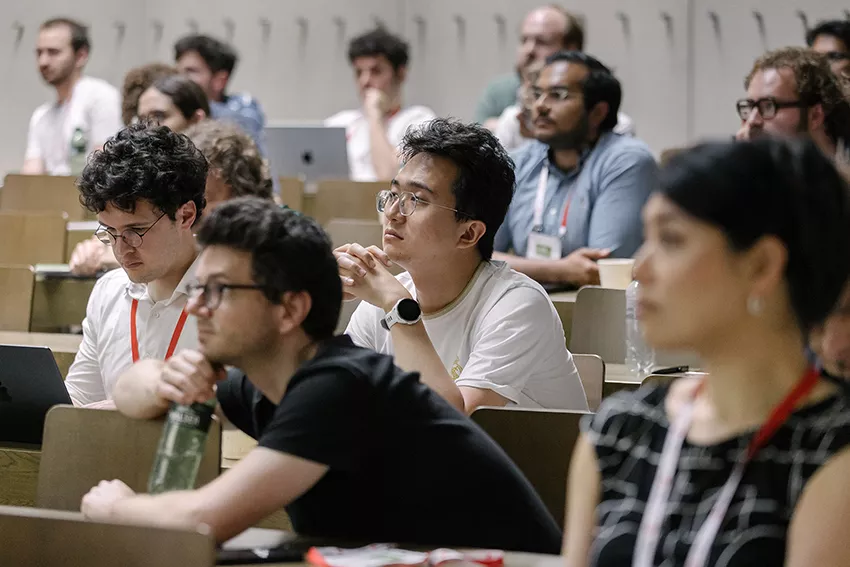
“One thing that made the networking sessions particularly interesting was that they created a space for students, researchers, HPC centres, and industry representatives to have open discussions rather than simply listen to technical presentations,” said Hussein Harake, Senior HPC Systems Engineer at CSCS and a member of the PASC26 organizing committee. Harake was the driving force behind this new addition to the PASC conference programme. He proposed the topics and chaired the discussions.
In total, six networking sessions took place over the three days of the conference: three round-table discussions and three additional sessions, in which vendor representatives spoke with students face-to-face.
The first round table, held on day one, focused on “Preparing students for careers in the AI and HPC era.” It revolved around a central question: How can universities, industry, and HPC centres better prepare students for careers in artificial intelligence and high-performance computing?
The discussions quickly showed that students often have a hard time judging what employers will actually expect from them once they graduate. Strong theoretical foundations still matter, but the participating experts from academia and industry repeatedly stressed that practical experience is just as important. This could mean taking part in hands-on projects, contributing to open-source software, joining hackathons, or gaining experience through internships and mentoring programmes. Exposure to real production systems was seen as particularly valuable, because it gives students a better understanding of how HPC environments operate in practice.
The sessions also highlighted how closely AI and HPC are now connected. They are no longer two separate fields but are increasingly part of the same computing ecosystem. Participants therefore suggested that universities may need to rethink their curricula by combining traditional HPC topics with AI and practical project work.
How AI is reshaping HPC
The round-table discussion of the second day took this conversation further, focusing on how AI is changing HPC—and what that means for students, universities, companies, and supercomputing centres.
One conclusion was clear: AI is no longer simply an additional workload running on supercomputers. Modern systems are increasingly being designed to support both large-scale simulations and AI applications. This shift is also changing the technical challenges faced by HPC centres. GPU computing, data movement, storage, networking, and energy efficiency are all becoming increasingly important.

For students entering the field, this means that the range of relevant skills is expanding. Programming, parallel computing and modern software engineering practices, including version control with Git, testing, and collaborative development, remain essential. At the same time, knowledge of AI and machine learning is increasingly becoming relevant in nearly every role.
Notably, communication, teamwork, adaptability, and a willingness to keep learning were mentioned just as often as technical skills. Across the round-table discussions, participants repeatedly returned to the same conclusion: the most valuable preparation students can gain before graduating is the chance to work on real HPC and AI systems as part of multidisciplinary teams.
What companies are looking for
The final round table on day three focused directly on career opportunities and concluded the series by addressing what companies are looking for in graduates. Representatives from NVIDIA, HPE, Huawei, E4, IBM, and IQM shared their perspectives on industry graduate programmes and internships. The company representatives agreed that practical project experience can often make a bigger difference than coursework alone. Their advice to students was therefore to get involved early, through internships, student programmes, research collaborations, and networking opportunities.
“For me, these networking sessions were a valuable addition to PASC this year,” Harake said. “Unlike traditional conference talks, they encouraged genuine dialogue between students, academia, HPC centres, and industry. Many of the discussions converged on the same message: preparing the next generation of HPC and AI professionals is a shared responsibility.”
Across the three days, the same themes surfaced again and again. AI and HPC are rapidly converging. Hands-on experience is becoming as important as theoretical knowledge. And students benefit enormously from internships, mentoring, and exposure to real production environments.
Perhaps the most important message was also the simplest: in a field evolving as quickly as HPC and AI, the ability to keep learning and adapting may be the most valuable skill of all.
Image credit: all photos by Marco Abram (CSCS)
About PASC Conference
The Platform for Advanced Scientific Computing (PASC) Conference is an interdisciplinary conference in HPC that brings together domain science, applied mathematics, and computer science—where computer science is focused on enabling the realization of scientific computation. The PASC Conference provides three days of stimulating and thought-provoking sessions, including keynote presentations, minisymposia, peer-reviewed papers, panels, and poster sessions. The conference is co-sponsored by ACM SIGHPC, and full papers are published in the ACM Digital Library.